
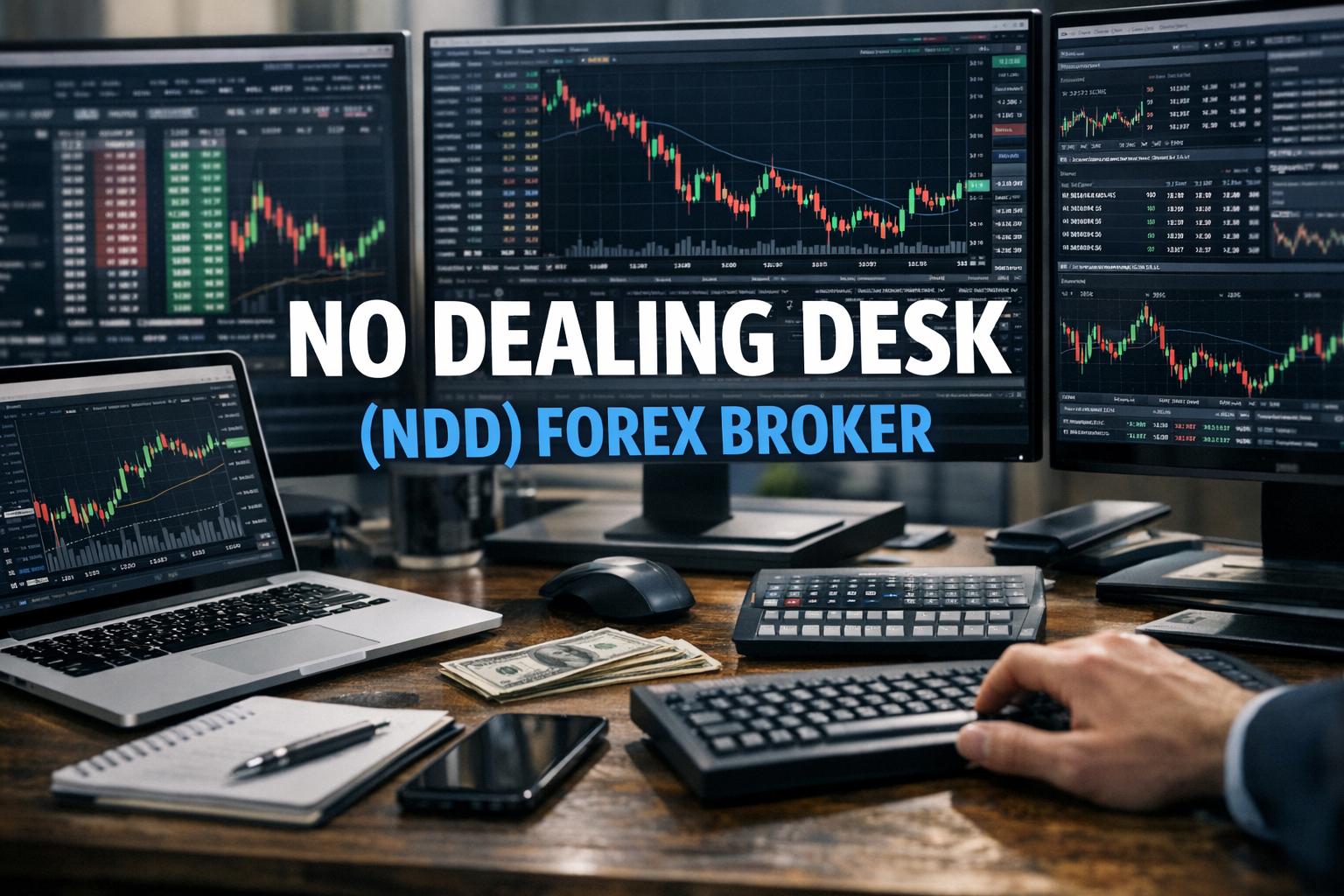
The foreign exchange market, commonly known as forex, is a decentralized global marketplace where currencies are traded. Participants include central banks, institutions, corporations, hedge funds, and retail traders. Within the retail trading segment, brokers act as intermediaries between individual traders and the broader currency market. One of the most discussed distinctions among brokers is whether they operate under a No Dealing Desk (NDD) model or another execution structure. Understanding how NDD brokers function is essential for traders evaluating execution quality, pricing transparency, and potential conflicts of interest.
Understanding the Broker’s Role in Forex Trading
Retail traders do not typically have direct access to the interbank currency market, where large financial institutions quote prices to one another. Entry into that environment generally requires substantial capital, credit lines, and institutional relationships. Brokerage firms bridge this gap by providing trading platforms, market data feeds, leverage arrangements, and access to liquidity pools.
In practical terms, a broker supplies the interface through which a trader views price quotes, places orders, monitors margin levels, and manages open positions. Behind that interface sits a technological and financial infrastructure that determines how trades are processed. This structure defines whether the broker internalizes client flow, offsets risk externally, or connects clients directly to outside liquidity providers.
The internal policies surrounding order routing shape trading outcomes in measurable ways. They influence spreads, slippage frequency, execution speed, and the likelihood of requotes. For this reason, the distinction between Dealing Desk (DD) and No Dealing Desk (NDD) models is central to understanding how a broker operates.
Dealing Desk Versus No Dealing Desk Structures
A traditional dealing desk broker, often referred to as a market maker, may quote its own prices to clients and assume the opposite side of their trades. While such brokers frequently hedge aggregate exposure in the broader market, they may initially internalize client orders. This structure can create scenarios in which the broker’s profit is indirectly linked to client losses.
By contrast, a No Dealing Desk (NDD) broker routes client orders directly to external counterparties. Instead of maintaining an internal dealing operation that manually reviews or adjusts trades, NDD brokers rely on automated systems connected to banks, hedge funds, and other liquidity providers. Revenue is typically generated through spreads, commissions, or a transparent combination of both.
The operational distinction does not automatically imply differences in regulatory status or reliability. However, it has implications for execution style, pricing methodology, and the distribution of trading risk.
What Defines a No Dealing Desk Broker?
A No Dealing Desk broker functions primarily as a conduit between retail clients and the interbank market. When a client submits a buy or sell order, the broker’s system automatically transmits that order to one or more external liquidity providers. The system selects the best available price according to predefined routing rules.
Unlike some dealing desk environments, there is no manual trade approval process. Orders are matched electronically at prevailing market prices. Because pricing is sourced from independent institutions rather than generated internally, bid and ask quotes reflect aggregated market supply and demand conditions.
NDD brokers usually operate under one of two technological frameworks: Straight Through Processing (STP) or Electronic Communication Network (ECN). Both models share the core principle of direct liquidity access, yet they differ in how prices are aggregated, displayed, and monetized.
Straight Through Processing (STP) Model
Under the STP model, client orders pass directly through the broker’s system to external liquidity providers without intervention. The broker may maintain relationships with several banks or financial entities, each supplying executable bid and ask quotes. These quotes are consolidated into a composite feed visible on the trading platform.
The STP system typically selects the best available combination of bid and ask prices at any moment. When a trader executes an order, the system routes it to the provider offering that price. In some cases, the broker may distribute large orders across multiple providers to secure sufficient liquidity, a process sometimes referred to as order splitting.
Revenue generation in STP accounts often relies on adding a modest markup to the raw spread. For example, if aggregate liquidity results in a 0.9 pip spread on a major currency pair, the broker may display 1.2 pips to clients. The 0.3 pip difference compensates the broker for facilitating access and maintaining infrastructure.
STP brokers generally promote automated processing, reduced requotes, and market-based pricing. However, transparency levels vary depending on how clearly spread markups and liquidity sources are disclosed.
Electronic Communication Network (ECN) Model
An ECN broker connects traders to a centralized electronic network where multiple liquidity providers and market participants submit competing orders. The network matches buy and sell interest in real time, often displaying the available volume at different price levels.
One distinguishing feature of ECN accounts is the use of raw spreads. Because quotes originate directly from liquidity providers and are not significantly marked up, spreads can narrow substantially in highly liquid conditions. Instead of embedding compensation within the spread, ECN brokers frequently charge a fixed commission per standard lot traded.
Market depth visibility is more common in ECN environments. Traders may see multiple price tiers beyond the top-of-book bid and ask. This Level II pricing can help assess short-term liquidity conditions, though it represents only the liquidity connected to that particular network rather than the entire global forex market.
Execution is typically conducted on a market execution basis, meaning trades fill at the best available price rather than a pre-quoted guaranteed rate. As a result, price changes between order submission and execution can lead to slippage in either direction.
Order Routing and Liquidity Aggregation
In NDD systems, the process of price formation is continuous. Liquidity providers stream bid and ask quotes to the broker’s aggregation engine. The engine ranks these quotes and constructs the tightest possible spread from available sources. This composite price feed is then transmitted to traders’ platforms.
When a client places an order, the routing algorithm determines the optimal counterparty based on price, available volume, and execution reliability statistics. Advanced aggregation systems can dynamically adjust routing preferences according to fill ratios and historical performance metrics of each provider.
This infrastructure requires significant technological investment. Data centers located near major financial exchanges reduce latency, while fiber-optic connections and optimized bridging software accelerate communication between trading platforms and liquidity venues.
Pricing Dynamics and Variable Spreads
Spreads in NDD accounts are commonly variable. They fluctuate in response to liquidity conditions, trading session overlaps, and macroeconomic events. During peak trading hours, such as when London and New York sessions overlap, liquidity tends to increase and spreads often narrow for major currency pairs.
In contrast, during off-peak periods or ahead of major economic announcements, liquidity may decline. Liquidity providers widen their quotes to compensate for increased uncertainty, and this widening is passed through to retail traders. Exotic currency pairs, which involve emerging market economies or less frequently traded currencies, often exhibit structurally wider spreads.
Evaluating cost efficiency requires analyzing average spreads over extended periods rather than relying solely on advertised minimum spreads. Minimum figures may occur only under optimal liquidity conditions and may not represent typical trading environments.
Slippage, Execution Quality, and Order Types
Slippage occurs when the executed price differs from the quoted price at the time of order submission. In NDD models, slippage reflects genuine market movement rather than dealer intervention. If the market shifts favorably, traders may experience positive slippage and receive a better price. If the market moves unfavorably, negative slippage occurs.
Execution quality depends on liquidity depth, server speed, and the type of order used. Market orders prioritize execution speed, while pending orders such as stop or limit entries activate once predefined price levels are reached. In rapidly moving markets, stop-loss orders may fill at levels beyond the requested price due to liquidity gaps.
Requotes are relatively uncommon in true NDD models because orders are not manually reviewed. Instead of rejecting an order and proposing a new quoted price, the system fills it at the next available rate.
Transparency and Reporting Standards
Transparency in NDD accounts extends beyond spreads. It involves clear disclosure of commission schedules, rollover rates, margin policies, and order execution procedures. Regulatory frameworks in established financial jurisdictions often require brokers to publish detailed execution statistics and maintain records demonstrating fair treatment of client orders.
Some brokers provide trade receipts showing the liquidity provider involved in each transaction. Others publish aggregated slippage statistics to illustrate historical execution performance. These disclosures can help traders compare brokers objectively.
Regulation and Client Fund Protection
Regulatory oversight plays a central role in assessing broker reliability. Authorities in major jurisdictions impose capital adequacy requirements, audit standards, and conduct-of-business rules. NDD brokers operating under recognized regulators are typically required to segregate client funds from company operational accounts.
Segregation reduces the risk that client deposits will be used for corporate expenses. In certain regions, investor compensation schemes provide limited financial coverage in the event of broker insolvency. The specifics vary by jurisdiction, making it important for traders to verify which entity holds their account.
Compliance obligations may also include clear risk disclosures, leverage limitations, and negative balance protection policies. These measures aim to reduce systemic risk and protect retail participants.
Technology Infrastructure and Latency Considerations
Because NDD brokers rely on automated routing, technology performance directly affects trade outcomes. High-frequency traders and algorithmic systems are particularly sensitive to latency. Even small delays between order transmission and execution can influence fill prices in fast-moving markets.
To address this, brokers often host trading servers in financial data centers such as those located in London, New York, or Tokyo. Co-location services allow liquidity providers and broker servers to operate within the same facilities, minimizing physical transmission distance.
Nevertheless, the trader’s local internet connection remains a factor. A stable, high-speed connection can reduce communication delays between the client terminal and broker server.
Suitability for Different Trading Strategies
NDD brokers are frequently selected by traders seeking alignment with interbank pricing conditions. Short-term traders, including scalpers and intraday participants, often value tight raw spreads and consistent execution policies. Commission-based ECN accounts may offer predictable transaction cost structures for such strategies.
Longer-term position traders may be less sensitive to minor variations in spreads. For them, rollover rates, swap policies, and regulatory framework may be more relevant considerations. Strategies involving algorithmic trading or automated systems may benefit from predictable market execution and minimal manual intervention.
Each trading style interacts with execution characteristics differently. Testing strategies in a demonstration or low-risk environment can provide insight into how variable spreads and slippage affect performance metrics.
Risk Management Framework in NDD Environments
Regardless of execution model, risk management remains essential. NDD brokers provide standard tools such as stop-loss and take-profit orders. Some also offer guaranteed stop-loss orders for specific instruments, though these may involve additional costs or wider spreads.
Margin requirements determine how much capital must be maintained to hold open positions. If account equity falls below maintenance thresholds, margin calls or automatic position closures may occur. Policies vary by regulator and by broker, making it advisable to review documentation carefully.
Negative balance protection, where available, ensures that client losses do not exceed deposited funds. This safeguard is mandatory in certain regulatory regions but may not be universally offered.
Structural Advantages and Limitations of NDD Brokers
The structural advantage of the NDD model lies in its reliance on external liquidity and automated routing. By separating client order flow from internal dealing operations, the broker’s revenue depends more directly on transaction volume than on client trading outcomes. This arrangement can reduce specific forms of conflict of interest.
However, exposure to authentic market conditions introduces variability. Traders must accept fluctuating spreads, potential slippage, and execution uncertainty during volatile events. Commission charges in ECN accounts must also be incorporated into performance evaluation.
The effectiveness of the model depends on liquidity quality, regulatory compliance, and infrastructure investment. Not all NDD brokers provide identical execution standards, and differences in aggregation technology can influence overall trading conditions.
Ongoing Evolution of the NDD Model
Advancements in financial technology continue to shape how NDD brokers operate. Improvements in matching engines, data processing speeds, and cross-border regulatory coordination have increased efficiency and transparency in retail forex trading. Competition among brokers has also encouraged clearer pricing structures and enhanced reporting.
At the same time, global regulatory scrutiny has intensified. Authorities seek to ensure that marketing claims regarding execution quality and liquidity access accurately reflect operational realities. This has led to more standardized disclosures concerning spreads, commissions, and order handling policies.
As electronic trading infrastructure evolves, the distinction between execution models may become more nuanced. Hybrid approaches exist in which brokers combine STP and ECN features or maintain partial internalization under defined conditions. Understanding documentation and execution policy statements remains central to informed decision-making.
Conclusion
No Dealing Desk (NDD) forex brokers represent an execution approach focused on routing client orders directly to external liquidity providers rather than internalizing them through a dealing desk. Within this category, STP and ECN models differ in spread construction, commission structure, and depth-of-market visibility.
NDD trading environments emphasize automated processing, market-based pricing, and reduced manual intervention. They provide access to variable spreads that reflect actual liquidity conditions and typically minimize the likelihood of requotes. In exchange, traders assume exposure to slippage and spread fluctuations inherent to real-time markets.
Selecting an appropriate NDD broker requires analysis of regulatory standing, order execution policies, fee transparency, infrastructure quality, and risk management safeguards. A detailed review of client agreements and execution documentation helps clarify how orders will be handled under different market conditions.
Within the broader structure of the global currency market, NDD brokers serve as technological intermediaries that connect individual traders to institutional liquidity networks. Their role continues to develop alongside advances in electronic trading systems and regulatory oversight frameworks.