
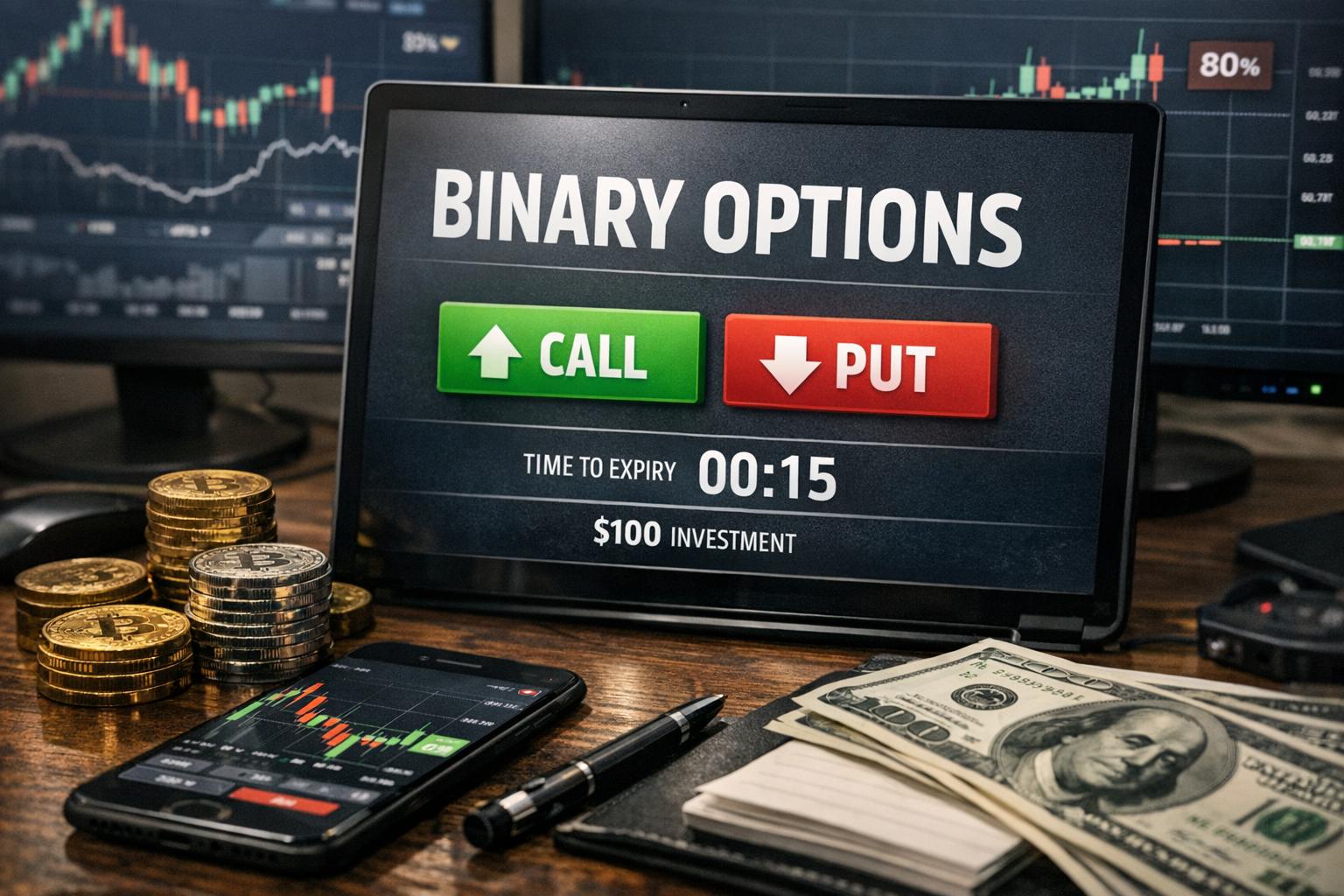
Binary options are a form of financial derivative that allows participants to speculate on the price movement of an underlying asset within a fixed period of time. The defining characteristic of binary options is their all-or-nothing payout structure. At expiration, the option settles either at a predetermined fixed amount or at zero, depending on whether the stated condition is met. This simplified payoff mechanism distinguishes binary options from traditional options such as calls and puts, where the payout typically varies according to the magnitude of the price movement.
Unlike conventional derivatives, where profit potential and loss exposure can expand or contract depending on market performance, binary options operate with a fixed and predetermined outcome. This structural distinction has shaped how they are marketed, regulated, and understood by both retail and institutional participants. Although frequently associated with short-term speculation, their design is rooted in established financial theory and probability modeling.
Basic Structure of Binary Options
A binary option contract is built around a simple proposition: will the price of an asset be above or below a specified level at a certain time? The participant selects an underlying asset, chooses a direction, sets an expiration time, and commits a stake. If the prediction is correct at expiration, the participant receives a fixed return. If it is incorrect, the entire stake is generally lost.
The underlying assets available for binary options vary by platform and may include currencies, stocks, commodities, and indices. On certain exchanges, interest rate benchmarks and volatility measures may also be used as reference assets. Regardless of asset class, the binary contract does not confer ownership rights. The holder does not acquire shares, currency units, or commodity exposure in the traditional sense. Instead, the position is purely derivative and cash-settled.
Each contract contains clearly defined parameters. These include the strike price (the reference level against which the final price is compared), the expiration date or time, and the payout amount. In exchange-traded formats, these terms are standardized. In over-the-counter environments, terms may vary depending on the provider.
Expiry times can range from extremely short intervals, such as 30 seconds or one minute, to days or months. Short-duration contracts are more common on retail platforms, while longer-dated binaries are often used in structured products or institutional applications. Settlement occurs automatically once the expiration time is reached, removing the need for manual exercise instructions.
Operational Mechanics and Trade Lifecycle
Once a binary option position is opened, its value may fluctuate prior to expiration, particularly on regulated exchanges where open positions can be sold before maturity. In such environments, pricing is dynamic and reflects changing market expectations about the underlying asset’s probability of satisfying the contract condition.
In proprietary platform models, early exit may or may not be available. Some providers permit closing a position before expiration at a quoted price, typically adjusted to reflect current probability estimates and internal risk management considerations. Others enforce a hold-to-expiry structure.
The trade lifecycle consists of initiation, monitoring, and settlement. Upon settlement, a clearing mechanism credits or debits the participant’s account according to the contract outcome. In regulated markets, clearinghouses ensure financial performance of the contract. In less regulated environments, the platform itself may act as counterparty and settlement agent.
Types of Binary Options
Binary options have evolved into several standardized formats. The most common form is the high/low option, also known as the call/put binary. In this format, the participant predicts whether the asset price will close above or below the strike price at expiration.
Another structure is the one-touch option. Here, the payout depends on whether the asset price touches a specified level at any time before expiration. Even a momentary price contact with the predetermined barrier is sufficient to trigger settlement. If the touch condition is met, the payout becomes locked in; if not, the option expires with no value.
The no-touch option represents the inverse of the one-touch structure. It pays out only if the underlying asset does not reach a designated level during the entire life of the contract. Pricing for these options is highly sensitive to volatility because even brief market spikes can determine the outcome.
The range option, sometimes described as an in/out option, involves predicting whether the asset price will remain within or move outside a predefined range at expiration. This structure introduces two boundaries rather than a single strike price.
Although these variations differ in execution details, they retain the central binary payoff logic. The contract settles at a fixed amount if the condition is satisfied and at zero if it is not.
Comparison with Traditional Options
Traditional options grant the holder the right, but not the obligation, to buy or sell an underlying asset at a specific strike price on or before expiration. The value of such options changes continuously with the underlying asset price. A call option becomes increasingly valuable as the asset price rises above the strike, and a put option increases in value as the asset price declines below it.
By contrast, binary options do not reflect the magnitude of price change. A movement of one unit beyond the strike generates the same payout as a movement of one hundred units. This absence of graduated payoff significantly alters risk-reward dynamics.
In traditional options trading, risk can be shaped through strategies such as spreads, straddles, and collars. These combinations allow traders to construct nonlinear payoff curves tailored to specific expectations. Binary options, however, embed their nonlinearity directly into the contract. Their payoff resembles a digital switch rather than a slope.
While binaries may appear simpler because outcomes are discrete, their pricing and statistical implications are not necessarily less complex. Accurate probability assessment remains essential, particularly when positions are taken repeatedly.
Pricing and Payout Mechanisms
Pricing frameworks differ between exchange-traded and platform-based binary options. On regulated exchanges, binary options are frequently quoted on a scale from zero to one hundred. The quoted price represents the market’s collective estimate of the probability that the contract will settle in the money, adjusted for discounting and trading considerations.
For example, if a binary contract is trading at 65, this implies a market view of approximately a 65 percent chance that the specified condition will be satisfied at expiration. A trader who purchases at 65 can potentially receive 100 at settlement, yielding a gross gain of 35, or lose 65 if the contract expires at zero.
Retail-oriented platforms often advertise fixed payout percentages. A participant may be offered an 80 percent return on a correct prediction. In that case, a stake of 100 yields 180 upon success (the original 100 plus 80 profit) or zero upon failure. The break-even win rate required to offset losses depends directly on this payout ratio.
In exchange environments, pricing models are frequently derived from adaptations of established option valuation frameworks. Under assumptions of lognormal price distribution, the value of a cash-or-nothing binary call option corresponds to the discounted probability that the asset price exceeds the strike at expiration. Implied volatility therefore plays a central role in determining price.
Regulatory Environment
The regulation of binary options varies significantly across jurisdictions. Supervisory authorities often evaluate them based on consumer protection concerns, transparency standards, and systemic risk implications.
In the United States, binary options are permitted only on exchanges regulated by the Commodity Futures Trading Commission (CFTC). These exchanges must comply with capital requirements, recordkeeping standards, and oversight procedures. Unauthorized offshore offerings targeting U.S. residents are prohibited.
Within the European Union, regulators implemented restrictions on the sale of binary options to retail investors. Authorities cited data indicating sustained net losses among non-professional participants. As a result, many jurisdictions either banned retail distribution or imposed stringent marketing limitations.
In other regions, binary options remain available under licensing frameworks that require risk disclosure, segregation of client funds, and dispute resolution mechanisms. Enforcement efforts frequently focus on unregistered cross-border operators and fraudulent schemes.
Risk Profile and Statistical Considerations
Binary options present a capped financial exposure equal to the initial stake. This defined maximum loss can simplify capital planning. However, the probability of incurring that loss may be substantial, particularly where payout ratios are structured below statistical fairness.
For example, if a platform offers an 80 percent return on successful trades, the break-even probability is higher than 50 percent. Over many transactions, a participant must achieve a win rate exceeding the implied threshold to avoid negative expectancy. The absence of progressive profits means that moderate forecasting advantages may not compensate for unfavorable payout structures.
Short-term expiration magnifies sensitivity to random price movements. Even when long-term analysis suggests a directional bias, immediate fluctuations can determine contract outcomes. This increases outcome variance and complicates predictive modeling.
Risk management in binary trading often involves position sizing discipline rather than stop-loss adjustments. Because the maximum loss is predefined, traditional risk mitigation tools such as trailing stops do not apply in the same manner.
Use in Hedging and Institutional Contexts
Although widely associated with individual speculation, binary options can perform targeted hedging functions. A corporation exposed to exchange rate fluctuations, for instance, might purchase a binary option that pays out if a currency crosses a threshold that would materially affect earnings. This allows protection against a discrete event without paying for continuous linear exposure.
In structured finance, digital components are frequently embedded within more complex derivatives. Investment banks may design products combining conventional options with binary triggers to meet defined payoff objectives. For institutional users, documentation adheres to standardized derivatives agreements, and pricing incorporates counterparty credit considerations.
Binary contracts may also reference economic releases. A contract could settle based on whether an inflation indicator exceeds a published benchmark. In such structures, the derivative transforms a forthcoming data point into a tradable probability expression.
Technological Platforms and Market Access
Online platforms facilitated the rapid expansion of retail binary trading. Web-based systems provide charting tools, automated execution, and near-instant account funding mechanisms. Low minimum deposit requirements have historically broadened accessibility.
Technological infrastructure supports real-time data analysis and automated risk balancing by providers. On exchange platforms, matching engines pair buyers and sellers transparently. In proprietary systems, algorithms may internally manage counterparty exposure through hedging or netting techniques.
However, technology has also enabled the operation of unlicensed entities. This has prompted regulatory authorities to strengthen verification requirements, restrict cross-border advertising, and mandate clearer disclosure language.
Behavioral and Market Dynamics
The structural design of binary options influences participant behavior. Because outcomes are resolved definitively at expiration, there is limited scope for adjusting partially profitable positions. The fixed payout ceiling may encourage frequent trading attempts aimed at capturing recurring small returns.
From a market perspective, liquidity depends on participation levels and structural transparency. Exchange-traded binaries typically display bid and ask prices determined by supply and demand. In contrast, over-the-counter platforms may determine quoted prices internally, which can create information asymmetries.
Market makers managing binary exposure often hedge by taking offsetting positions in underlying assets or correlated derivatives. Near expiration, hedging activity can intensify due to the steep payoff gradient around the strike price.
Criticism and Controversies
Binary options have generated regulatory scrutiny due to documented abuses among certain providers. Concerns have included unclear probability disclosures, refusal to process withdrawals, and conflicts of interest where the operator directly profits from client losses.
These issues led to enforcement actions, license revocations, and coordinated international investigations. Distinguishing between regulated exchange-traded contracts and unregulated offshore offerings remains essential when assessing credibility and investor protection standards.
The industry’s contraction in some regions has been linked primarily to compliance failures rather than to the theoretical structure of the derivative itself.
Mathematical Perspective
From a quantitative standpoint, the value of a binary option equals the discounted probability of the defined condition occurring. In continuous-time finance theory, a cash-or-nothing binary call pays a fixed amount if the asset price exceeds the strike at expiration. Its valuation can be derived from the cumulative distribution function of the assumed price process.
Volatility significantly influences price. Higher expected volatility increases the likelihood that extreme price levels will be reached, raising the value of certain binary structures such as one-touch contracts. Time to expiration also plays a role, as longer durations generally expand the probability distribution range.
Sensitivity metrics comparable to traditional Greeks can be calculated. Delta measures price sensitivity relative to the underlying asset, though it can change sharply near expiration. Gamma may become concentrated as expiry approaches, reflecting the discontinuity in payoff. These characteristics require precise risk calibration by institutional traders.
Accounting and Tax Considerations
In regulated markets, binary options are typically treated as derivative instruments for accounting purposes. Gains and losses may be recognized as capital or ordinary income depending on jurisdictional tax law and trading classification. Institutional participants must record fair value adjustments consistent with applicable accounting standards.
Tax treatment varies internationally. Some authorities classify exchange-traded binaries similarly to other listed derivatives, while others apply specific rules for short-duration financial instruments. Participants are generally expected to maintain transaction records reflecting entry price, exit price, and settlement outcome.
Conclusion
Binary options represent a specialized category of derivative defined by a fixed, all-or-nothing payout profile. They enable market participants to take positions on whether a specific price condition will occur within a designated time frame. Although structurally straightforward, their valuation depends on probability estimation, volatility assessment, and disciplined capital management.
Regulatory treatment differs across jurisdictions, with some permitting exchange-traded contracts under strict supervision and others restricting retail availability. Risk exposure is limited to the initial stake, yet long-term outcomes depend heavily on payout ratios and predictive accuracy.
A comprehensive understanding of binary options requires analysis of contract mechanics, pricing logic, supervisory frameworks, and statistical expectancy. When evaluated within these parameters, they can be viewed not merely as simplified trading instruments but as discrete probability-based derivatives embedded in the broader financial system.