
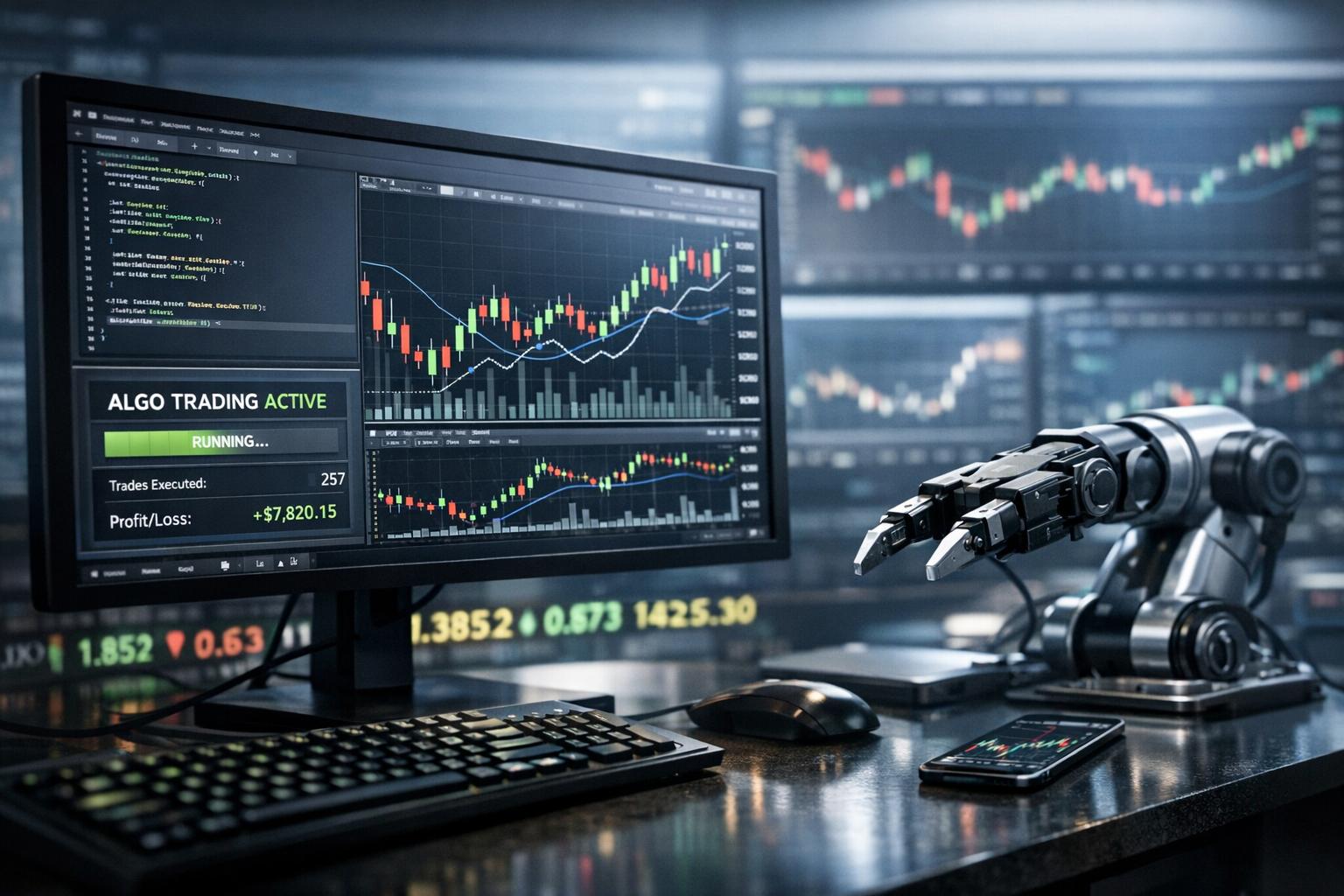
Automated trading refers to the use of computer programs to enter and manage financial market orders according to predefined rules. These systems, often described as algorithmic trading systems, execute trades automatically when specified market conditions are met. Automated trading is widely used in equity markets, foreign exchange, futures, options, and increasingly in digital asset markets. It ranges from relatively simple rule-based models implemented by individual traders to complex, high-frequency infrastructures operated by institutional firms.
The core purpose of automated trading is to reduce direct human intervention in the trading process. By encoding strategy rules into software, traders aim to remove discretionary bias, standardize execution, and allow objective evaluation of performance. Human decision-making can be influenced by stress, cognitive bias, or inconsistency. Automation seeks to ensure that predefined logic is applied uniformly across market conditions. In addition, machines operate with speed and the capacity to process large volumes of data, characteristics that are difficult to replicate manually.
The development of electronic exchanges and application programming interfaces (APIs) has played a central role in making automated trading accessible. Modern brokers provide structured connectivity that allows external programs to receive live market data, submit orders, and monitor account status in real time. As infrastructure has matured, automation has evolved from a niche institutional practice into a broadly adopted methodology across professional and retail participants.
Historical Development of Automated Trading
The foundation of automated trading emerged from the digitization of financial markets in the late twentieth century. For much of modern market history, trading occurred through physical exchanges using open outcry systems. Orders were transmitted verbally and matched manually. While effective for its time, this structure limited the speed and scale of transactions. As computing technology advanced, exchanges began implementing electronic order book systems, allowing participants to enter orders through terminals rather than floor brokers.
During the 1980s and 1990s, institutional investors introduced program trading, which enabled simultaneous execution of multiple securities based on predefined criteria. This was particularly useful for index replication and portfolio rebalancing. Program trading reduced the operational burden of executing large baskets manually and improved pricing consistency.
In the early 2000s, electronic markets became dominant across major asset classes. Improvements in network latency, server processing speeds, and routing systems made it possible to automate increasingly complex strategies. Firms specializing in high-frequency trading developed infrastructures that minimized execution delays to microsecond ranges. Co-location services, which place trading servers in close physical proximity to exchange data centers, reduced transmission time further.
Retail participation expanded as brokerage platforms integrated scripting capabilities and visual strategy builders. Traders without advanced programming backgrounds gained the ability to encode rule-based strategies. Over time, automation has come to represent a substantial proportion of total trading volume in developed markets. Concurrently, regulatory frameworks have adapted to address potential systemic risks associated with widespread algorithmic execution.
Core Components of an Automated Trading System
An automated trading system typically consists of interconnected modules that operate continuously during market hours. At the center lies the strategy logic component. This defines the mathematical and procedural conditions that trigger entries, exits, adjustments, and cancellations. Strategy logic may include trend indicators, price pattern recognition, volatility thresholds, macroeconomic inputs, or statistical models.
The second major element is market data input. Reliable data feeds deliver price quotes, trade reports, order book depth, and historical series used for calculations. Data integrity is essential. Delayed or inaccurate data can lead to false signals or incorrect pricing. Depending on strategy requirements, traders may use tick-level data, aggregated bars, or specialized feeds containing corporate actions and economic releases.
The execution engine converts trading signals into actionable orders. It communicates with the broker or exchange through authenticated APIs, formats order messages correctly, and manages order states such as submission, partial fill, cancellation, and confirmation. Execution modules often include logic to prevent duplicate orders and to handle unexpected disconnections. More advanced implementations integrate smart order routing, selecting among multiple liquidity venues to seek price improvement.
Risk management controls are embedded within the system to limit undesired exposure. These controls monitor open positions, margin usage, and cumulative profit or loss. Predefined limits may prevent new trades once certain thresholds are met. Automated safeguards can immediately close positions if specific risk parameters are breached. Because automated systems can operate at high speed, internal controls must be systematic and independent of primary signal logic.
The final component involves infrastructure and monitoring tools. Hosting environments may include local servers, dedicated data center machines, or cloud-based deployments. Logging systems record every decision and transaction for later review. Monitoring dashboards provide real-time visibility into system health, latency metrics, and performance statistics. Even a fully automated strategy requires oversight to detect hardware failures, connectivity interruptions, or anomalous behavior.
Strategy Design and Types
Automated trading strategies vary widely in objective and structure. A prominent category consists of trend-following systems, which aim to identify directional price persistence. These strategies typically respond to breakouts above resistance levels or crossovers of moving averages. The objective is to capture sustained directional movement and exit once momentum weakens or reverses. Trend-following systems can operate across time frames ranging from intraday intervals to multi-month horizons.
Mean reversion systems take the opposite conceptual approach. They assume that price deviations from a statistical norm may be temporary. When metrics such as standard deviation bands or relative strength measures indicate overextension, the system initiates positions anticipating a return toward an average level. This logic is commonly applied in pairs trading, where price relationships between correlated assets are analyzed for divergence.
Arbitrage strategies focus on exploiting pricing discrepancies between related instruments. Examples include differences between futures and underlying spot prices, cross-exchange currency mismatches, or valuation gaps between exchange-traded funds and their constituent assets. Because such discrepancies are often brief, arbitrage strategies emphasize rapid order placement and precise synchronization of data feeds.
Market-making algorithms continuously post bid and ask quotes to capture the bid-ask spread. They manage inventory risk by adjusting quotes in response to market movement and position size. Effective market-making requires modeling order flow, queue position, and short-term volatility. Small miscalculations in spread width or inventory exposure can influence profitability.
Advances in computational capacity have expanded the use of machine learning-based systems. Supervised learning models use labeled historical data to forecast price direction or volatility. Unsupervised techniques identify structural patterns without explicit outcome labels. Reinforcement learning methods attempt to optimize sequential trade decisions by maximizing cumulative reward functions. While these approaches allow flexible modeling of nonlinear relationships, they require careful validation to ensure robustness across different market regimes.
Backtesting and Optimization
Backtesting is the systematic evaluation of a trading strategy on historical data. By applying predefined rules to past market conditions, traders can measure theoretical returns, volatility, drawdowns, and trade frequency. Backtesting provides a structured method to compare alternative strategy designs before allocating capital.
However, historical simulation has limitations. Markets evolve due to regulatory change, macroeconomic shifts, and technological development. A strategy that performed well during low-volatility environments may face difficulty in high-volatility periods. Therefore, robust backtesting includes segmentation of data into in-sample and out-of-sample periods. The model is calibrated on one data subset and validated on another to reduce bias.
Overfitting represents a primary concern in strategy development. When a model is excessively optimized to match historical noise, it may not generalize effectively. Limiting parameter complexity, applying walk-forward analysis, and conducting cross-validation across diverse market periods are common methods used to control overfitting risk.
Accurate modeling of transaction costs is essential. Commissions, exchange fees, bid-ask spreads, slippage, and potential market impact can significantly alter net performance. For higher-frequency strategies, minor cost miscalculations compound rapidly. Backtests must therefore incorporate realistic assumptions regarding execution quality and liquidity constraints.
Optimization seeks to identify parameter combinations that improve performance metrics while maintaining stability. Rather than selecting a single optimal configuration, developers often evaluate parameter ranges to identify stable regions where performance remains consistent across slight variations. Stability is generally preferred over peak historical profitability, as it suggests stronger structural validity.
Execution and Market Microstructure
Understanding market microstructure enhances the effectiveness of automated trading. Electronic markets operate through limit order books, where buy and sell orders are arranged by price and time priority. The sequence in which orders are placed can determine fill probability. Short-term strategies depend heavily on queue dynamics and liquidity distribution.
Latency, defined as the interval between signal generation and confirmation of execution, directly affects execution outcomes. For high-frequency systems, microseconds can influence queue position and slippage. Retail systems, typically operating through internet connections, face greater latency and therefore often concentrate on longer holding periods where slight delays have limited impact.
Order type selection forms part of execution design. Market orders guarantee immediate matching at prevailing prices but expose the trader to potential slippage in fast-moving markets. Limit orders specify price boundaries but may remain unfilled. Conditional orders such as stop-loss or trailing stop instructions automate exit management based on evolving prices. Sophisticated algorithms dynamically shift between order types depending on liquidity conditions.
Risk Management and Capital Allocation
Risk management frameworks in automated trading operate at both trade and portfolio levels. Position sizing methods determine how much capital is allocated to each trade. Some systems employ fixed fractional models, risking a constant percentage of account equity per trade. Others adjust allocation based on volatility estimates, reducing size during turbulent conditions.
Drawdown monitoring provides an additional control layer. If cumulative losses exceed predefined percentages, systems may halt further trading pending review. Such mechanisms help prevent extended performance deterioration. Portfolio-level management evaluates correlations among multiple strategies to avoid concentration in similar risk factors.
Stress testing assesses potential outcomes under extreme yet plausible scenarios. Historical crisis periods, abrupt interest rate shifts, or significant price gaps can be simulated to estimate resilience. Automated systems designed for continuous operation must anticipate the possibility of large, rapid movements that deviate from typical daily fluctuations.
Regulatory and Compliance Considerations
Financial authorities supervise automated trading to maintain orderly markets. Regulatory frameworks may require firms to implement pre-trade risk filters that prevent erroneous orders or excessive order flow. Large participants often face mandatory testing standards before deploying new algorithms in live markets.
Record-keeping obligations typically include detailed storage of order messages, timestamped execution reports, and documentation of system modifications. These audit trails enable regulators to reconstruct trading activity if irregularities occur. Compliance policies frequently address prohibited practices such as spoofing, which involves placing orders without intent to execute.
Exchanges may implement circuit breakers that pause trading during abrupt price movements. Automated systems must be configured to respond appropriately to such interruptions. In cross-border operations, additional considerations arise regarding market access rules and reporting standards specific to each jurisdiction.
Infrastructure and Technology Stack
The technological structure supporting automated trading depends on scale and objectives. Individual traders may utilize desktop platforms or virtual private servers to maintain continuous connectivity. Institutional operators often deploy distributed systems with redundant failover mechanisms to enhance reliability.
Programming languages such as Python facilitate rapid strategy prototyping and data analysis. Performance-sensitive components may be written in C++ or similar languages to minimize latency. Integration with secure databases ensures efficient storage of historical time-series data and trade records. Encryption protocols and authentication procedures protect API credentials and sensitive account information.
System maintenance requires regular updates, performance audits, and contingency planning. Backup power supplies, redundant internet connections, and automated restart scripts reduce downtime risk. Continuous monitoring tools generate alerts when anomalies arise in execution speed, order rejection rates, or capital utilization.
Advantages and Limitations
Automated trading offers structural consistency by applying rules precisely as coded. It allows systematic analysis of large data sets and simultaneous monitoring of multiple instruments. Continuous operation across global sessions supports participation in twenty-four-hour markets such as foreign exchange and digital assets.
Limitations arise primarily from model assumptions and technical vulnerabilities. Software errors, hardware malfunctions, or inaccurate data can generate unintended outcomes. Strategies derived from historical relationships may lose effectiveness if those relationships change. Market regimes are not static, and periodic review of model validity is required.
Automation does not eliminate the need for human oversight. Strategic adjustments, structural evaluation, and compliance management remain responsibilities that require judgment beyond code execution. Effective implementation combines systematic precision with informed supervision.
Future Developments
Ongoing advances in artificial intelligence and data science are influencing automated trading methodologies. Increasing computational power allows more detailed simulations and real-time processing of alternative data sets, including textual analysis and geospatial information. Cloud-based infrastructure provides scalable environments for research and live deployment.
Hardware acceleration technologies, such as graphics processing units and specialized chips, contribute to performance improvements in data-intensive calculations. As technological capacity expands, regulatory oversight is likely to continue adapting to maintain resilience and transparency within financial systems.
Automated trading represents a structural transformation in how financial markets operate. By integrating algorithmic logic, disciplined risk controls, robust execution infrastructure, and ongoing validation processes, market participants implement systematic strategies across asset classes. Continuous refinement, careful testing, and regulatory compliance remain central to sustainable operation in an increasingly automated marketplace.