
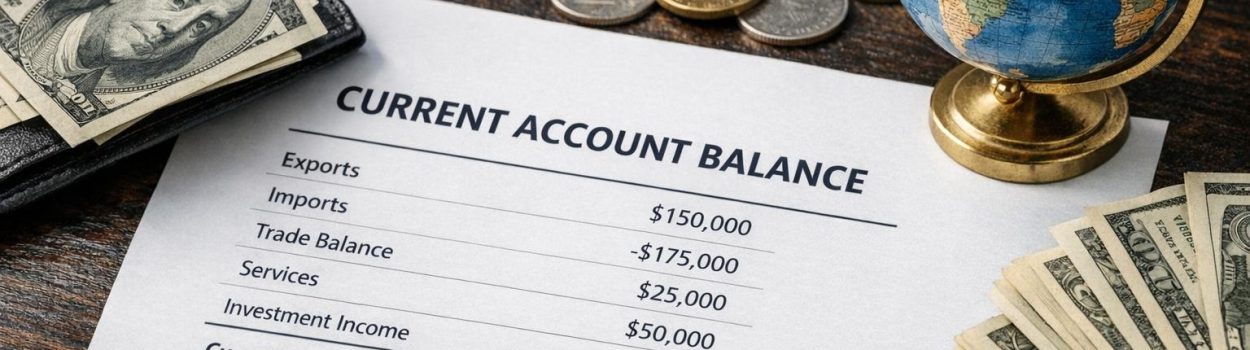
The current account balance is one of the most closely monitored indicators in international macroeconomics. It provides a structured record of a country’s economic transactions with the rest of the world over a defined period, typically quarterly or annually. By measuring flows of goods, services, income, and transfers across borders, the current account reveals whether a country is accumulating claims on foreign economies or increasing its obligations to them. For policymakers, analysts, investors, and financial institutions, it serves as a central gauge of external sustainability, competitiveness, and macroeconomic stability.
Although public discussion often focuses narrowly on trade deficits or surpluses, the current account is broader and more structurally informative. It captures not only visible trade flows but also financial returns on cross-border investments and government or private transfers. When interpreted alongside capital flows, exchange rates, savings behavior, and fiscal policy, it becomes a powerful tool for understanding global capital allocation and domestic economic dynamics.
Definition and Core Structure
The current account forms a major component of a country’s balance of payments, the comprehensive accounting framework that records all economic transactions between residents and non-residents. The balance of payments is divided into three main accounts: the current account, the capital account, and the financial account. Together, these accounts ensure that all international transactions are systematically recorded according to internationally accepted accounting standards.
The current account focuses specifically on transactions related to production, income generation, and transfers. In simplified terms, it answers the question: is a country earning more from the rest of the world than it is paying, or vice versa? If inflows exceed outflows, the result is a current account surplus. If outflows exceed inflows, the country records a deficit.
From a macroeconomic perspective, the current account balance reflects whether a country is acting as a net lender or a net borrower in the global economy during a given timeframe. A surplus implies that residents are supplying savings to the rest of the world, increasing their holdings of foreign assets. A deficit means the country is drawing on foreign savings to finance domestic consumption or investment.
Main Components of the Current Account
The current account consists of four principal components: trade in goods, trade in services, primary income, and secondary income, sometimes referred to as current transfers. Each element captures a distinct category of cross-border economic activity, and together they provide a comprehensive measure of external transactions.
Trade in Goods
Trade in goods, commonly known as the merchandise trade balance, includes exports and imports of tangible products. Exports represent domestically produced goods sold to foreign buyers, while imports represent goods produced abroad and purchased by domestic residents. The difference between exports and imports determines whether the country runs a goods surplus or a goods deficit.
This component frequently dominates headlines because merchandise trade figures are large, visible, and politically salient. Industrial economies that specialize in manufacturing often generate substantial export revenues from machinery, vehicles, electronics, or chemicals. Resource-rich economies may depend heavily on commodity exports such as crude oil, agricultural products, or metals.
Movements in global commodity prices can significantly influence the goods balance. For example, a country reliant on oil exports may see its trade surplus expand during periods of high energy prices and narrow when prices decline. Similarly, shifts in global supply chains, trade policy frameworks, and technological change can reshape a country’s goods balance over time.
Trade in Services
The services component captures cross-border transactions involving intangible outputs. These include tourism, transportation, financial intermediation, insurance, information technology services, telecommunications, education, healthcare, and payments for intellectual property rights.
As many advanced economies have transitioned toward service-oriented production structures, the importance of services trade has expanded considerably. Countries with internationally competitive banking sectors, digital firms, entertainment industries, or consulting services often maintain sustained surpluses in services.
In some cases, a services surplus offsets a merchandise trade deficit. An economy may import large quantities of consumer goods while exporting high-value services such as software development or asset management. This illustrates that competitiveness in the global economy extends beyond physical production and includes knowledge-based and network-based industries.
Primary Income
Primary income measures cross-border flows of earnings related to ownership of factors of production. It includes compensation of employees working abroad and, more significantly, investment income such as dividends, reinvested earnings, and interest payments.
Countries that have accumulated substantial foreign direct investment assets or portfolio holdings can receive steady streams of income from abroad. These income inflows may support a current account surplus even when trade balances are modest. Conversely, economies that rely heavily on foreign capital inflows may record sustained primary income outflows due to profit repatriation and interest payments to foreign investors.
This component highlights the importance of a country’s net international investment position, which measures the difference between external assets owned by residents and domestic assets owned by foreigners. Over time, persistent current account surpluses tend to strengthen this position, while deficits may weaken it.
Secondary Income (Current Transfers)
Secondary income consists of transfers in which one party provides resources to another without receiving a direct economic return. These include personal remittances sent by migrant workers to their home countries, foreign aid, and contributions to international organizations.
In some developing economies, remittance inflows represent a significant share of national income and a stabilizing source of foreign exchange. Such transfers can moderate trade deficits and support domestic consumption. Although secondary income flows are generally smaller than trade or investment income flows in large economies, they can be structurally important for specific countries.
Current Account Surplus and Deficit Dynamics
A current account surplus indicates that a country’s total external receipts exceed its external payments. This outcome implies that the economy is accumulating foreign financial assets or reducing foreign liabilities. Surpluses are often associated with high domestic savings rates, strong export sectors, or restrained domestic demand relative to production capacity.
A current account deficit arises when external payments exceed receipts. To finance this gap, a country must attract capital from abroad. These capital inflows are recorded in the financial account of the balance of payments and may take the form of foreign direct investment, portfolio flows into equity or bond markets, or cross-border lending.
It is important to note that neither surpluses nor deficits are inherently problematic. Their implications depend on underlying structural conditions. A deficit may reflect productive investment opportunities that attract foreign capital and enhance long-term growth. Conversely, a surplus may reflect subdued domestic demand or demographic characteristics that encourage high savings.
Savings, Investment, and Macroeconomic Identity
A fundamental macroeconomic identity links the current account balance to domestic savings and investment. Specifically, the current account equals national savings minus domestic investment. This identity provides a deeper analytical perspective than trade flows alone.
If national savings exceed domestic investment, excess savings must be deployed abroad, resulting in a current account surplus. If domestic investment exceeds savings, the difference must be financed with foreign capital, generating a deficit. This framework demonstrates that the current account is shaped not only by international competitiveness but also by fiscal balances, household savings preferences, corporate retained earnings, and demographic trends.
For example, expansionary fiscal policy that increases government deficits may reduce overall national savings, potentially widening the current account deficit if private savings and investment remain unchanged. Similarly, shifts in corporate investment cycles can influence external balances independently of trade policy measures.
Exchange Rates and External Adjustment
The exchange rate is a central variable influencing the current account. When a currency depreciates, domestically produced goods and services become relatively less expensive for foreign buyers, while imports become more costly for domestic consumers. Over time, this relative price adjustment can encourage export growth and moderate import demand.
However, the adjustment process is not instantaneous. The J-curve effect describes a situation in which a currency depreciation initially worsens the trade balance because import prices rise before export volumes respond. Only after quantities adjust does the trade balance begin to improve.
Exchange rate movements interact with structural competitiveness factors such as productivity, quality of infrastructure, regulatory efficiency, and technological innovation. A favorable exchange rate alone cannot ensure a sustainable surplus if underlying production capacity is weak.
Financing and Financial Market Implications
When a country runs a deficit, it must rely on external financing. The composition of these inflows matters. Long-term foreign direct investment is generally considered more stable than short-term portfolio flows or foreign currency-denominated borrowing. A deficit financed through productive investment may strengthen growth capacity, while one financed by short-term speculative inflows may increase vulnerability.
Shifts in global financial conditions can alter the availability and cost of external financing. Rising global interest rates, declining investor confidence, or geopolitical uncertainty may trigger capital outflows, currency depreciation, and higher domestic borrowing costs. For emerging market economies, managing the scale and structure of current account deficits is often central to financial stability policy.
Government Policy and Structural Reform
Governments influence current account outcomes through fiscal policy, monetary policy, and structural reforms. Fiscal consolidation can raise public savings and potentially narrow deficits. Monetary policy affects interest rates and exchange rates, indirectly influencing capital flows and trade competitiveness.
Long-term structural measures—such as investment in education, innovation, and infrastructure—can enhance export capacity and reduce reliance on imported goods. Trade policies may alter bilateral trade flows, but unless they affect underlying savings and investment balances, their impact on the overall current account may be limited.
Global Imbalances and International Coordination
At the global level, current account balances must sum to zero. One country’s surplus corresponds to another’s deficit. Persistent imbalances can reflect structural differences in demographics, financial development, and consumption preferences. Capital flows from surplus to deficit countries allocate resources across borders, supporting investment and consumption smoothing.
Concerns arise when imbalances are associated with excessive debt accumulation, asset price bubbles, or misaligned exchange rates. In such cases, abrupt adjustments can disrupt financial markets and economic growth. International policy coordination sometimes aims to address large and persistent global imbalances through macroeconomic rebalancing strategies.
Measurement and Interpretation
National statistical agencies compile current account data based on standardized methodologies. These data are typically reported in both nominal currency terms and as a percentage of gross domestic product. Expressing the balance relative to GDP facilitates cross-country comparison and sustainability analysis.
A modest deficit relative to GDP may be consistent with strong investment-driven growth, while a large and persistent deficit may prompt closer examination of external debt levels and financing structures. Analysts often examine trends over multiple years rather than isolated quarterly fluctuations to assess stability.
Long-Term Sustainability and Risk Assessment
Evaluating sustainability requires considering external debt ratios, currency composition of liabilities, growth prospects, and institutional strength. Countries with diversified export bases, credible policy frameworks, and stable financial systems may sustain deficits for extended periods. Conversely, weak institutions or heavy reliance on short-term foreign currency borrowing can increase exposure to external shocks.
Persistent surpluses also carry implications. They may lead to significant reserve accumulation or expansion of sovereign investment funds. At times, sustained surpluses prompt policy discussions regarding domestic demand stimulation or currency adjustment to facilitate global rebalancing.
Conclusion
The current account balance offers a comprehensive measure of a country’s economic relationship with the rest of the world. By integrating trade in goods and services, cross-border investment income, and transfer payments, it reflects the interplay between savings, investment, and international competitiveness.
Understanding the current account requires examining macroeconomic fundamentals, financial market conditions, and structural characteristics of the economy. Surpluses and deficits both arise from complex interactions among domestic policies, private sector behavior, and global capital flows. When assessed in context, the current account remains an essential indicator of external position, economic resilience, and long-term sustainability in an increasingly integrated global economy.