
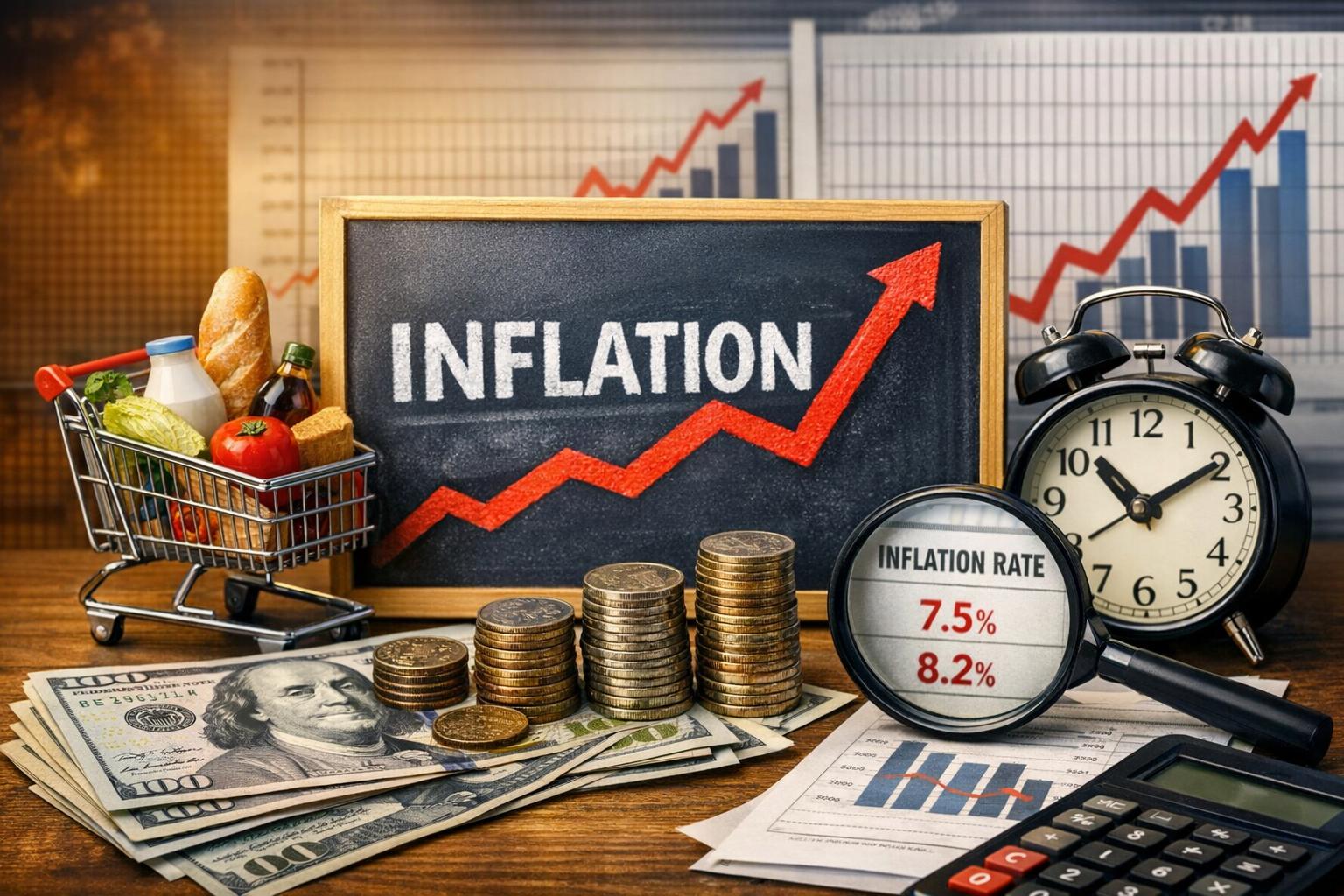
Inflation refers to the sustained increase in the general price level of goods and services over a period of time. When inflation rises, each unit of currency buys fewer goods and services, which means purchasing power declines. Inflation is a central concept in macroeconomics because it affects interest rates, wages, savings, investments, government policy, and overall economic stability. Understanding how inflation works, how it is measured, and how it influences economic decisions is essential for individuals, businesses, investors, and policymakers operating in modern financial systems.
Definition and Core Concepts
Inflation measures the rate at which prices increase over time. It is typically expressed as an annual percentage rate. For example, if inflation is 3 percent in a given year, prices have increased on average by 3 percent compared to the previous year. Inflation does not refer to the price of a single product or service but to a broad-based increase across a representative group of goods and services within an economy.
The opposite of inflation is deflation, which occurs when the general price level declines over a sustained period. Although lower prices may initially appear beneficial, persistent deflation can create economic challenges. Consumers may delay purchases in anticipation of further price declines, which can reduce corporate revenues, investment, and employment. Falling prices may also increase the real burden of debt, making it harder for borrowers to service loans.
A related concept is disinflation, which describes a slowdown in the rate of inflation. Prices continue to increase, but at a lower pace than previously observed. Disinflation often occurs when central banks implement tighter monetary policies to prevent the economy from overheating.
Inflation is also categorized according to its intensity. Creeping inflation refers to low and relatively stable price increases, often viewed as consistent with economic growth. Walking or galloping inflation denotes more rapid price increases that can disrupt long-term contracts and savings decisions. Hyperinflation represents an extreme scenario characterized by exceptionally high and typically accelerating inflation rates, often exceeding 50 percent per month. In such cases, confidence in the currency may deteriorate significantly, and normal economic activity becomes difficult to sustain.
How Inflation Is Measured
Economists use several statistical tools to measure inflation. The most common approach involves constructing and monitoring price indices. A price index tracks the average change in prices for a selected basket of goods and services over time. The basket is designed to reflect typical spending patterns within a population group.
The Consumer Price Index (CPI) is one of the most widely recognized measures. It captures changes in prices paid by households for categories such as food, housing, transportation, healthcare, education, and recreation. Statistical agencies periodically update the composition and weightings of the basket to reflect changes in consumer behavior. Monthly or quarterly data collection allows authorities to estimate the inflation rate over different time horizons.
Another important indicator is the Producer Price Index (PPI), which measures changes in prices received by domestic producers. By focusing on wholesale or production-level prices, the PPI can provide insight into cost pressures within supply chains. Increases in producer prices may eventually pass through to consumers, although the transfer is neither immediate nor guaranteed.
The GDP deflator offers a broader measure of inflation. It reflects price changes for all domestically produced final goods and services within an economy. Unlike the CPI, which relies on a fixed basket, the GDP deflator adjusts to shifts in consumption and investment patterns. This flexibility allows it to capture structural changes in economic activity.
Some central banks also monitor core inflation, which excludes volatile components such as food and energy. These items may experience short-term price swings due to weather events, geopolitical developments, or supply shocks. By focusing on core measures, policymakers attempt to identify underlying inflation trends that may be more responsive to monetary policy.
Causes of Inflation
Inflation can result from a variety of interconnected factors. Economists often distinguish between demand-pull inflation, cost-push inflation, and inflation driven by changes in the money supply.
Demand-pull inflation occurs when aggregate demand exceeds aggregate supply. When households increase consumption, businesses expand investment, or governments raise spending during periods of strong economic growth, demand may outpace the economy’s productive capacity. Limited supply relative to demand can exert upward pressure on prices. This type of inflation is often observed in expanding economies with tightening labor markets.
Cost-push inflation arises from rising production costs. If wages, energy prices, transportation expenses, or raw material costs increase, firms may adjust their selling prices to maintain profit margins. Supply chain disruptions, regulatory changes, or commodity price spikes can amplify these effects. For example, sustained increases in oil prices can influence a wide range of sectors due to the central role of energy in production and transportation.
Inflation may also emerge from monetary factors. According to the quantity theory of money, sustained expansion of the money supply beyond the growth rate of real output can lead to higher price levels. If more money circulates while the volume of goods and services remains relatively stable, nominal demand may increase, placing upward pressure on prices.
Imported inflation represents another channel. When a country relies heavily on imported goods, currency depreciation can raise the domestic price of those goods. Exchange rate movements therefore play a significant role in shaping inflation dynamics, particularly in open economies integrated into global trade networks.
The Role of Central Banks
Central banks are responsible for maintaining price stability in most modern economies. Their primary instrument is monetary policy, which involves managing short-term interest rates and influencing liquidity conditions within the financial system.
When inflation rises above target levels, central banks may increase policy interest rates. Higher rates raise borrowing costs for households and businesses, which can moderate credit growth, reduce aggregate demand, and ease price pressures. In addition to conventional rate adjustments, central banks may use open market operations, reserve requirements, and forward guidance to influence financial conditions.
In periods of low inflation or deflation risk, central banks may reduce interest rates to stimulate economic activity. Lower borrowing costs can encourage consumption, housing investment, and business expansion. In exceptional cases, policymakers may implement unconventional monetary policies, such as quantitative easing, which involves purchasing financial assets to inject liquidity into the economy.
Many central banks operate under an explicit inflation targeting regime. They publicly announce a numerical inflation goal, often around 2 percent per year. The objective is to anchor expectations and provide transparency regarding policy intentions. Credibility is central to this framework; if households and businesses believe that inflation will remain near target, their price-setting and wage-setting behavior is more likely to align with that assumption.
Inflation Expectations and Wage Dynamics
Inflation expectations influence how economic agents behave. Expectations are formed based on past inflation rates, central bank communication, labor market conditions, and global developments. When individuals expect higher future inflation, they may adjust wage demands, pricing strategies, and investment decisions accordingly.
A persistent rise in expectations can contribute to a wage-price spiral. In this scenario, workers demand higher wages to compensate for anticipated cost-of-living increases. Employers, facing higher labor expenses, may respond by raising product prices. These price increases can reinforce expectations of future inflation, perpetuating the cycle.
Central banks monitor surveys of households and businesses, as well as market-based indicators such as inflation-linked bond yields, to assess expectations. Maintaining anchored expectations reduces the likelihood that temporary price shocks will translate into sustained inflationary pressures.
Impact on Households and Real Income
Inflation directly affects real income, which represents income adjusted for price changes. If nominal wages increase at a slower pace than inflation, purchasing power declines. This erosion is particularly relevant for individuals on fixed incomes, such as retirees receiving fixed pension payments.
Savings are also influenced by inflation. When the interest rate earned on deposits is lower than the inflation rate, the real value of savings decreases over time. This dynamic may encourage households to seek alternative investments that offer returns exceeding inflation, including equities, real estate, or inflation-protected securities.
Borrowers may experience a redistribution effect. If loans carry fixed interest rates, rising inflation reduces the real value of outstanding debt. Conversely, lenders receive repayments with lower purchasing power. Variable-rate loans may adjust in response to central bank rate changes, altering this balance.
The distributional effects of inflation vary across income groups. Households that allocate a large share of their budgets to essential goods may be more vulnerable when prices of those goods rise disproportionately. Consequently, the composition of inflation matters as much as its aggregate rate.
Impact on Businesses and Corporate Planning
Inflation affects corporate cost structures, pricing strategies, and investment planning. Moderate and predictable inflation can facilitate adjustments in relative prices and wages. However, high or volatile inflation increases uncertainty and complicates long-term contracts.
Firms must evaluate whether rising input costs can be passed on to consumers. In competitive industries, the ability to transfer higher costs may be limited, potentially compressing profit margins. In sectors with stronger pricing power, companies may adjust prices more readily.
Capital budgeting decisions also depend on expected inflation. When projecting future cash flows, companies must account for both nominal revenue growth and rising costs. Uncertainty regarding future monetary policy can delay or alter investment decisions, particularly for projects with long time horizons.
Impact on Financial Markets and Asset Allocation
Financial markets are sensitive to changes in inflation data and expectations. Fixed-income securities are particularly exposed because their payments are typically fixed in nominal terms. Rising inflation reduces the real value of these payments, leading investors to demand higher yields. As yields increase, existing bond prices decline.
Equity markets respond to inflation in more complex ways. Moderate inflation aligned with economic expansion may support revenue growth. However, if inflation accelerates sharply and prompts aggressive monetary tightening, equity valuations may face downward pressure due to higher discount rates and weaker expected earnings.
Commodities and real assets are sometimes viewed as partial hedges against inflation, as their prices may increase alongside broader price levels. Additionally, instruments such as Treasury Inflation-Protected Securities (TIPS) adjust principal values according to inflation indices, providing a mechanism to preserve real purchasing power.
Fiscal Policy and Structural Factors
Government fiscal policy interacts with inflation dynamics. Increased public spending or tax reductions can stimulate aggregate demand, potentially contributing to inflationary pressure if productive capacity is constrained. Conversely, reductions in spending or higher taxes may moderate demand and inflation.
Structural characteristics of an economy also shape inflation outcomes. Labor market flexibility, productivity growth, demographic trends, and global supply integration influence how quickly demand pressures translate into price increases. Technological innovation may exert downward pressure on prices by improving efficiency and expanding supply.
Historical Patterns and Policy Lessons
Historical episodes illustrate the diversity of inflation experiences. The 1970s were marked by elevated inflation in many advanced economies, driven by oil price shocks and accommodative monetary conditions. The subsequent tightening of monetary policy in the early 1980s demonstrated the capacity of central banks to reduce inflation, albeit with short-term economic costs.
Hyperinflationary episodes, such as those experienced in interwar Europe and more recently in certain emerging markets, highlight the consequences of uncontrolled monetary expansion and fiscal instability. In contrast, prolonged low inflation or deflation, as observed in Japan for several decades, underscores the challenges associated with weak demand and entrenched expectations of stable or falling prices.
Balancing Inflation and Economic Growth
Policymakers aim to maintain a balance between price stability and sustainable economic growth. Very low inflation may signal insufficient demand, while high inflation can distort price signals and discourage investment. A moderate and stable rate of inflation is generally considered conducive to long-term planning and efficient resource allocation.
The Phillips curve framework has historically suggested a short-term trade-off between inflation and unemployment. Although the strength of this relationship varies across periods and countries, it remains a useful analytical tool in macroeconomic assessment. Structural reforms, credible monetary policy, and prudent fiscal management contribute to maintaining inflation within a range compatible with stable growth.
Conclusion
Inflation rate remains a core indicator of macroeconomic performance. It reflects changes in purchasing power, influences interest rate decisions, and affects income distribution, corporate profitability, and financial market valuations. Measured through instruments such as the CPI, PPI, and GDP deflator, inflation arises from demand conditions, production costs, monetary factors, and global influences.
Central banks, supported by transparent communication and credible policy frameworks, play a fundamental role in anchoring expectations and maintaining price stability. The effects of inflation depend not only on its level but also on its volatility and persistence. A stable inflation environment contributes to predictable financial planning, efficient investment decisions, and sustainable long-term economic development.