
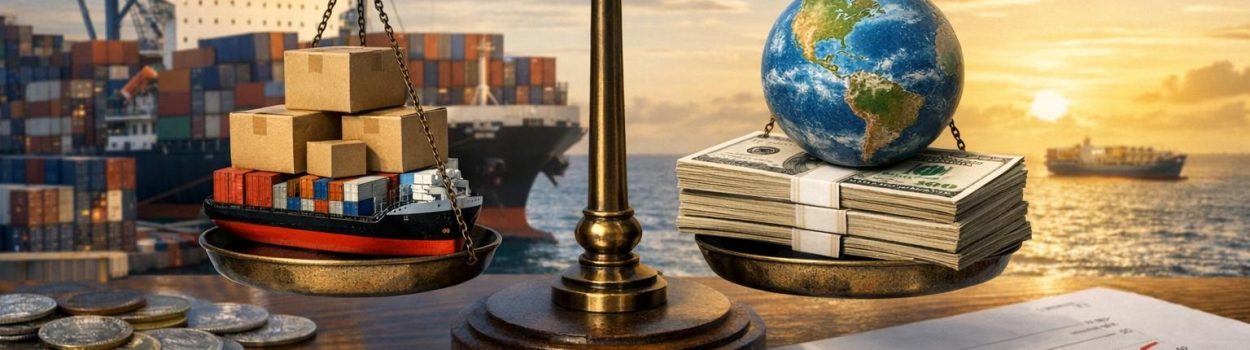
The trade balance is a central concept in international economics. It measures the difference between a country’s exports and imports of goods and services over a specific period. When exports exceed imports, a country records a trade surplus. When imports exceed exports, it records a trade deficit. Although the calculation appears straightforward, the implications of trade balances extend into economic growth, employment, exchange rates, industrial structure, capital flows, and government policy.
Trade balance figures are typically reported on a monthly, quarterly, and annual basis by national statistical agencies. They form part of a broader framework known as the balance of payments, which records all economic transactions between residents of one country and the rest of the world. While the trade balance captures flows of goods and services, the wider balance of payments includes cross-border investment, interest payments, transfers, and changes in reserve assets. Understanding the trade balance therefore requires examining both trade flows and the financial mechanisms that accompany them.
Definition and Measurement
The trade balance is calculated by subtracting the total value of imports from the total value of exports over a defined period:
Trade Balance = Exports − Imports
A positive result indicates a surplus, while a negative figure reflects a deficit. These values are commonly expressed in domestic currency terms, though international comparisons frequently convert them into a widely traded currency such as the US dollar.
Exports consist of domestically produced goods and services sold abroad. Goods include agricultural commodities, energy products, consumer goods, intermediate components, and capital equipment. Services encompass a broad range of activities such as tourism, transportation, banking, insurance, consulting, education, entertainment, and digital platform services. Imports mirror these categories but refer to products and services purchased from foreign producers.
Trade data are generally recorded on either a free on board (FOB) or cost, insurance, and freight (CIF) basis. The distinction relates to whether transportation and insurance costs are included in the reported value of goods. Such measurement conventions can affect the comparison of trade balances across countries.
In addition, trade statistics may be presented in nominal or real terms. Nominal data reflect current prices, while real figures adjust for inflation to better capture changes in volume. Analysts often focus on real trade balances when assessing underlying economic trends.
Components of Goods and Services Trade
Goods trade traditionally accounts for a large share of total cross-border exchange. Manufactured products such as automobiles, electronics, machinery, and pharmaceuticals dominate many advanced economies’ export profiles. Resource-rich countries often export commodities including oil, gas, minerals, and agricultural products. The composition of exports influences the volatility of the trade balance, as commodity prices can fluctuate significantly.
Services trade has expanded steadily with globalization and technological development. Financial centers may record substantial surpluses in financial and business services. Countries with established tourism sectors often generate significant export revenues from travel spending by foreign visitors. The growth of digitalization has enabled cross-border provision of software, cloud computing, and intellectual property licensing, increasing the importance of intangible exports.
Some economies exhibit contrasting patterns between goods and services. It is possible to observe persistent goods deficits offset by services surpluses, resulting in a more balanced overall trade position. The relative strength of services can therefore alter the interpretation of aggregate trade figures.
Historical Context and Economic Thought
The interpretation of trade balances has evolved over centuries. Under mercantilism, prevalent from the 16th to 18th centuries, policymakers viewed trade surpluses as essential to national wealth. Governments implemented tariffs and navigation laws to restrict imports and promote exports, aiming to accumulate gold and silver reserves.
The development of classical economics shifted this perspective. David Ricardo’s theory of comparative advantage demonstrated that mutual gains from trade arise when countries specialize according to relative efficiency rather than seek persistent surpluses. In this framework, trade imbalances can reflect differences in capital availability, productivity, and consumer preferences.
During the 20th century, the expansion of multinational corporations and global supply chains altered the structure of international commerce. Intermediate goods now cross borders multiple times before final assembly. As a result, gross trade data may obscure where value is actually created. Modern trade analysis increasingly incorporates value-added measures to better understand economic contributions.
Determinants of Trade Surpluses and Deficits
Several macroeconomic factors influence whether a country runs a trade surplus or deficit. One central driver is domestic demand. When households, firms, and governments spend heavily, a portion of that expenditure falls on imports. Strong domestic growth therefore often correlates with widening trade deficits, particularly if domestic production cannot meet rising demand.
Foreign demand conditions are equally important. Economic expansion among trading partners can boost exports, improving the trade balance. Export-oriented economies are therefore sensitive to global growth cycles.
Exchange rates represent another key determinant. A depreciation of the domestic currency lowers the foreign-currency price of exports and raises the domestic price of imports. Over time, such adjustments can narrow deficits or expand surpluses, although the effect may be gradual due to existing contracts and supply chain structures. Conversely, currency appreciation can make exports relatively expensive and imports cheaper, potentially leading to larger deficits.
The relationship between savings and investment also shapes trade outcomes. In macroeconomic accounting terms, a trade deficit corresponds to a situation in which domestic investment exceeds national saving. The excess investment is financed through capital inflows from abroad. Surplus countries typically save more than they invest domestically, supplying capital to the rest of the world.
Structural characteristics such as labor productivity, educational attainment, infrastructure quality, technological capability, and regulatory frameworks influence export competitiveness. Countries with strong research and development capacity may develop high-value export sectors. Resource endowments also matter; energy exporters often experience surpluses during commodity price booms and deficits when prices decline.
Trade Balance and Gross Domestic Product
The trade balance directly affects a nation’s gross domestic product (GDP) through the expenditure approach to national accounting:
GDP = Consumption + Investment + Government Spending + (Exports − Imports)
The term exports minus imports is known as net exports. When net exports are positive, they add to GDP. When negative, they reduce GDP relative to what it would otherwise be. Changes in export or import growth can therefore influence quarterly GDP fluctuations.
However, interpreting this relationship requires caution. A reduction in imports may mathematically increase net exports and thus GDP, but if falling imports reflect weakening domestic demand, overall economic conditions may not be improving. Similarly, rising imports during periods of strong investment and consumption can coincide with robust growth despite a widening deficit.
Sectoral and Regional Impacts
Trade balances have differentiated effects across industries and regions. Export-oriented sectors such as aerospace, advanced manufacturing, or agricultural production may expand employment and capital investment when foreign demand is strong. Firms integrated into global markets often benefit from economies of scale and increased revenue diversification.
In contrast, industries that compete directly with imported goods can face competitive pressure. Adjustments may involve cost reductions, technological upgrades, or shifts toward higher-value production. Labor markets can experience transitional challenges if workers must move between sectors or acquire new skills.
Regional variation within countries often reflects exposure to international trade. Port cities and logistics hubs may prosper due to increased cross-border activity. Manufacturing-intensive regions may experience volatility tied to global demand conditions. These distributional effects influence domestic policy debates surrounding trade agreements and industrial strategy.
Exchange Rate Regimes and Adjustment Mechanisms
The manner in which trade imbalances adjust depends partly on the exchange rate regime. Under a floating exchange rate, currency values are determined by market forces. Persistent deficits can lead to depreciation as demand for foreign currency rises to pay for imports. Over time, this depreciation may help correct the imbalance by stimulating exports and restraining imports.
In a fixed exchange rate or managed system, authorities intervene to maintain currency stability. Adjustment then occurs through changes in domestic prices, wages, or output rather than through exchange rate movements. Sustained deficits may reduce foreign exchange reserves and prompt policy responses such as fiscal tightening or structural reform.
Countries running prolonged surpluses may accumulate substantial foreign exchange reserves. These reserves can provide liquidity during financial stress but may also reflect limited domestic absorption relative to production capacity.
The Trade Balance within the Balance of Payments
The trade balance forms a major component of the current account, alongside net income from abroad and net current transfers. A current account deficit indicates that a country is a net borrower from the rest of the world. This borrowing is recorded in the financial account, which includes foreign direct investment, portfolio flows, and other cross-border financial transactions.
By accounting identity, the sum of the current account and the financial account, adjusted for statistical discrepancies, equals zero. Consequently, a trade deficit must be offset by net capital inflows. These inflows may take the form of foreign acquisitions of domestic assets, government bond purchases, or private sector lending.
The composition of financing is significant. Long-term foreign direct investment aimed at establishing productive capacity may enhance future export performance. Short-term debt inflows can increase vulnerability to sudden capital reversals, particularly if investor confidence shifts.
Policy Approaches to Trade Imbalances
Governments respond to trade imbalances through a combination of trade, macroeconomic, and structural policies. Trade measures such as tariffs and quotas directly influence import volumes. Export promotion initiatives, including credit support or trade facilitation measures, may encourage outward sales. However, unilateral protectionist actions can trigger retaliation and disrupt established supply chains.
Fiscal policy affects the balance through its impact on national saving. Large fiscal deficits can contribute to current account deficits by reducing public saving. Fiscal consolidation may narrow external imbalances if it increases overall national saving. Monetary policy, by influencing interest rates and exchange rates, also indirectly shapes trade flows.
Structural reforms designed to enhance productivity, streamline regulation, and support innovation can improve competitiveness over time. Investment in transportation infrastructure, education systems, and digital connectivity may strengthen export capacity without directly restricting imports.
Global Imbalances and Systemic Considerations
Persistent global imbalances arise when some major economies maintain large surpluses while others sustain significant deficits. These patterns reflect differences in demographic trends, income levels, fiscal policies, and financial market development. High-saving economies may channel excess funds into global capital markets, while high-consumption economies absorb those funds.
International organizations monitor such patterns because abrupt adjustments can disrupt financial stability. Coordinated policy discussions often emphasize the need for surplus countries to encourage domestic demand growth and for deficit countries to enhance saving and competitiveness.
Assessing bilateral trade balances can be misleading, particularly when supply chains span multiple countries. A product assembled in one economy may contain components sourced from several others. Value-added trade statistics attribute export earnings to the economy where production actually generates value, providing a clearer understanding of interdependence.
Trade Balance in Developing and Emerging Economies
In developing economies, trade balances can influence exchange rate stability, inflation, and external debt sustainability. Export revenues derived from a narrow range of commodities may create vulnerability to price volatility. Diversification strategies aimed at expanding manufacturing or services exports are often central to long-term development planning.
Emerging markets with rapid infrastructure expansion may run temporary trade deficits as they import capital goods. If these investments enhance productive capacity, future export growth may offset earlier deficits. The timing and efficiency of such investments are critical to ensuring that external borrowing remains sustainable.
Contemporary Trends and Structural Changes
Technological progress continues to reshape global trade. Digital platforms facilitate cross-border commerce for small and medium-sized enterprises. Services delivered electronically challenge traditional distinctions between goods and services transactions. Data flows increasingly underpin trade in finance, entertainment, and professional services.
Environmental policy considerations are also gaining prominence. Measures such as carbon pricing and border adjustment mechanisms can influence comparative costs, potentially affecting trade balances between jurisdictions with differing climate policies. Energy transition strategies may alter the trade positions of fossil fuel exporters and renewable technology producers.
Geopolitical developments, including shifts toward regional supply chains or trade diversification strategies, may gradually reconfigure global patterns. Such changes can modify bilateral balances while leaving broader macroeconomic relationships intact.
Conclusion
The trade balance provides a concise numerical summary of a country’s external trade in goods and services. While the calculation of exports minus imports is straightforward, the interpretation of surpluses and deficits requires analysis of savings and investment behavior, exchange rate dynamics, sectoral competitiveness, and global financial flows.
Trade imbalances are not inherently indicative of strength or weakness. They may signal structural inefficiencies or reflect productive investment and growth opportunities. Evaluating their significance requires consideration of financing patterns, macroeconomic conditions, and long-term development objectives.
Within an interconnected global economy, the trade balance remains a critical indicator. Its relationship to GDP, the balance of payments, exchange rates, and sectoral performance ensures that it continues to inform economic analysis, policy formulation, and international coordination.