
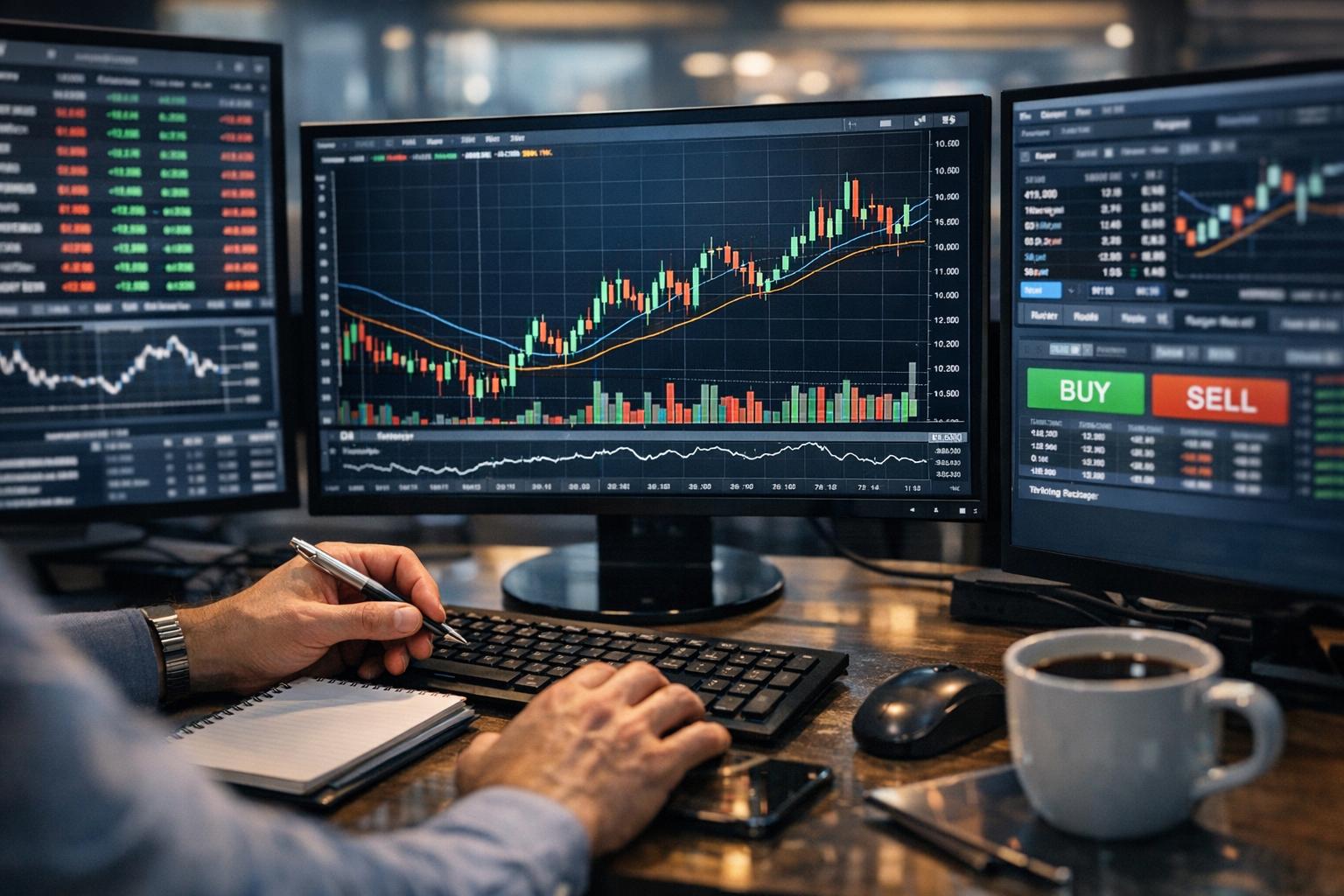
Trading refers to the process of buying and selling financial instruments such as stocks, bonds, commodities, currencies, and derivatives with the objective of generating a return. Unlike long-term investing, which typically focuses on gradual appreciation and income over extended periods, trading emphasizes shorter-term opportunities driven by price movements. The practice operates across various markets and instruments, supported by exchanges, brokers, technology platforms, clearing systems, and regulatory structures that facilitate orderly transactions.
At its core, trading is an exchange of risk between market participants. One participant may seek to reduce exposure to price fluctuations, while another may be willing to assume that risk in pursuit of profit. This transfer of risk is fundamental to the functioning of modern capital markets and underpins liquidity and efficiency across asset classes.
Foundations of Financial Markets
Modern trading takes place within organized financial markets that connect buyers and sellers through standardized mechanisms. These markets may be centralized exchanges, such as national stock exchanges and futures exchanges, or decentralized systems, such as the foreign exchange market conducted through a network of banks and financial institutions. Each structure has distinct operational characteristics, but all aim to ensure transparency, efficiency, and fairness in price formation.
Price discovery occurs through the interaction of supply and demand. When buyers are willing to pay higher prices than sellers are offering, transactions occur at rising levels. Conversely, when sellers accept progressively lower bids, prices decline. This continuous negotiation establishes market-clearing prices and reflects collective expectations about future economic conditions, company performance, and risk factors.
Liquidity refers to the ease with which assets can be bought or sold without significantly affecting their market price. Highly liquid markets typically have large numbers of participants, narrow bid-ask spreads, and substantial trading volumes. Lower liquidity often increases the cost of trading and may lead to more pronounced price swings when sizeable orders enter the market. Liquidity conditions vary across asset classes, geographic regions, and time of day.
Another foundational concept is market efficiency, which proposes that prices incorporate available information. While no market is perfectly efficient at all times, the rapid dissemination of news and widespread access to trading platforms have generally increased the speed at which information is reflected in asset prices.
Market Participants and Intermediaries
A diverse group of participants contributes to market dynamics. Institutional investors, including pension funds, mutual funds, insurance companies, and hedge funds, account for a significant share of trading volume in many markets. Their strategies range from long-term asset allocation to high-frequency execution models.
Retail traders participate either independently or through brokerage firms. The growth of online platforms has broadened access to global markets, enabling individuals to trade equities, currencies, futures, and derivatives using relatively modest capital.
Brokers act as intermediaries between traders and markets. They provide execution services, margin financing, custody arrangements, and analytical tools. Some brokers operate on an agency basis, routing orders directly to exchanges or liquidity providers, while others may act as counterparties in certain over-the-counter transactions.
Clearinghouses and settlement systems complete the trade lifecycle by ensuring contractual obligations are fulfilled. They manage counterparty risk through margin requirements and guarantee mechanisms, thereby enhancing systemic stability.
Major Asset Classes in Trading
Trading spans multiple asset classes, each characterized by unique drivers and structural features. Equities, or stocks, represent ownership interests in publicly listed companies. Equity prices reflect expectations about future earnings, competitive positioning, industry trends, and macroeconomic developments. Corporate announcements, earnings releases, and mergers frequently influence short-term price volatility.
Fixed income securities, including sovereign and corporate bonds, involve contractual cash flows in the form of interest payments and principal repayment. Bond prices generally move inversely to changes in interest rates. Traders in fixed income markets closely monitor inflation data, monetary policy announcements, and credit conditions. Changes in perceived creditworthiness can materially affect bond valuations.
Foreign exchange (forex) trading involves the simultaneous purchase of one currency and sale of another. Because international trade and capital flows require currency conversion, the forex market operates continuously during the global business week. Exchange rates are influenced by interest rate differentials, inflation expectations, political developments, and shifts in global risk sentiment.
Commodities include energy products, metals, and agricultural goods. Commodity prices often respond to physical supply and demand conditions, weather events, inventory data, and geopolitical disruptions. For example, disruptions in oil supply chains can lead to rapid adjustments in energy futures markets.
Derivatives, such as futures, options, and swaps, derive their value from underlying assets. Futures contracts obligate parties to transact at predetermined prices on specified dates, while options provide the right but not the obligation to transact. Derivatives enable participants to hedge exposures or speculate on price movements with defined contractual terms. Their use of margin and embedded leverage requires careful risk assessment.
Order Types and Execution Mechanics
The manner in which orders are placed can significantly affect trade outcomes. A market order instructs execution at the best available price, prioritizing speed over price certainty. A limit order specifies the maximum purchase price or minimum sale price, ensuring price control but not guaranteeing execution.
Additional order instructions, such as stop and stop-limit orders, are used to manage risk or enter markets upon confirmation of price thresholds. Sophisticated execution algorithms may divide large orders into smaller components to minimize market impact and reduce slippage, which refers to the difference between expected and actual execution prices.
Execution quality depends on multiple factors including liquidity, volatility, order size, and routing efficiency. Traders often evaluate brokers based on metrics such as fill rates, execution speed, and cost transparency.
Types of Trading Approaches
Trading strategies differ in time horizon and analytical framework. Day trading involves opening and closing positions within the same session, seeking to capture intraday price variability. Participants typically rely on real-time charts, order book data, and short-term technical indicators.
Swing trading spans several days or weeks and aims to benefit from intermediate price movements. Traders in this category frequently combine technical signals with macroeconomic or corporate developments that may influence trends.
Position trading extends over longer durations, sometimes months. Although it shares elements with investing, it maintains a focus on timing entry and exit points to optimize risk-adjusted performance.
Algorithmic trading employs automated systems that execute orders based on predefined criteria. These systems may incorporate statistical arbitrage models, trend-following logic, or liquidity-provision strategies. Institutional market participants rely extensively on algorithmic infrastructure to manage large transaction volumes efficiently.
Technical Analysis
Technical analysis examines historical price and volume patterns to identify potential future movements. Charting techniques include line charts, bar charts, and candlestick representations, each conveying information about opening, closing, high, and low prices.
Indicators such as moving averages smooth price data to highlight prevailing direction. Momentum oscillators measure the rate of price change and may signal overbought or oversold conditions. Support and resistance levels denote areas where buying or selling interest has historically emerged, potentially influencing subsequent movements.
Trend identification is central to technical frameworks. An uptrend is characterized by successive higher highs and higher lows, while a downtrend exhibits the opposite configuration. Traders frequently monitor trend strength to avoid entering positions counter to prevailing momentum without sufficient justification.
Fundamental Analysis
Fundamental analysis seeks to estimate intrinsic value by evaluating financial statements, economic data, and qualitative factors. In equity markets, analysis often includes revenue growth, profit margins, capital structure, and competitive advantages. Valuation models such as discounted cash flow analysis project future earnings to estimate fair value ranges.
In currency markets, macroeconomic indicators such as inflation, employment statistics, and central bank communications play substantial roles. Monetary policy decisions influence interest rate expectations, which in turn affect currency demand and capital flows.
Commodity analysis may incorporate production quotas, transportation constraints, and seasonal consumption patterns. By integrating quantitative and qualitative information, traders attempt to contextualize price behavior within broader economic frameworks.
Risk Management and Capital Preservation
Risk management is integral to trading sustainability. Uncertainty is unavoidable, and even well-researched strategies can produce adverse outcomes. Structured controls help limit potential damage from unfavorable price movements.
Position sizing determines capital allocation for each trade. Limiting exposure to a small proportion of total equity can reduce the probability of substantial drawdowns. Stop-loss orders establish predefined exit levels to constrain downside risk, while take-profit levels may define target returns.
Diversification across instruments or strategies may mitigate concentrated exposure. However, correlations can shift during periods of market stress, potentially diminishing diversification benefits. Continuous monitoring of leverage ratios is essential, particularly in derivative markets where margin calls may occur if equity falls below required thresholds.
Psychological Dimensions of Trading
Market outcomes are influenced by collective human behavior. Cognitive biases such as overconfidence and anchoring may distort objective assessment. Traders who adhere to systematic rules and predefined risk parameters are generally better positioned to maintain consistency.
Discipline involves executing trades according to established criteria rather than reacting impulsively to short-term volatility. Many professionals document their rationale and review performance data to identify recurring strengths and weaknesses. A structured trading plan often outlines entry triggers, risk limits, and review procedures.
The Role of Technology
Technological innovation has transformed trading operations. Electronic platforms provide direct market access, integrated charting software, and data feeds that update in real time. Cloud computing and advanced analytics enable complex simulations and backtesting of strategies using historical datasets.
High-frequency trading systems operate with extremely low latency, capitalizing on minimal price discrepancies across venues. While such systems enhance liquidity under normal conditions, they also require rigorous oversight to mitigate operational and systemic risks.
Machine learning techniques are increasingly applied to large datasets, identifying correlations that may not be immediately apparent through conventional analysis. Predictive modeling, however, remains subject to model risk and overfitting, underscoring the need for validation and transparent methodology.
Regulatory Environment
Regulation promotes orderly markets and protects participants from misconduct. Authorities establish rules regarding disclosure, market manipulation, and financial reporting. Licensing requirements govern brokers and exchanges, ensuring compliance with capital adequacy and operational standards.
Clearing organizations and market operators implement surveillance systems to detect irregular trading patterns. Cross-border coordination among regulators has increased as trading activity spans multiple jurisdictions and electronic networks.
Costs and Performance Measurement
Transaction costs directly influence net profitability. Brokerage commissions, spreads, exchange fees, and financing charges for leveraged positions accumulate over time. Active strategies must account for these expenses when assessing expected returns.
Performance evaluation often considers volatility and drawdown in addition to absolute return. Risk-adjusted metrics such as the Sharpe ratio or maximum drawdown analysis provide insight into the consistency and stability of results across varying market environments.
Global Interconnections and Macroeconomic Influences
Financial markets are interconnected across regions and asset classes. Policy decisions by major central banks can affect bond yields, currency values, and equity valuations worldwide. Capital flows respond to relative growth prospects, interest rate differentials, and geopolitical stability.
Macroeconomic announcements, including employment data and inflation releases, frequently generate short-term volatility. Traders evaluate both the reported data and deviations from consensus expectations, as surprises often trigger pronounced price adjustments.
Ethical Considerations and Market Conduct
Ethical standards support trust and transparency in financial markets. Practices such as insider trading, front running, and market manipulation undermine equitable price formation and may result in significant legal penalties. Robust compliance systems aim to detect and prevent such conduct.
Institutional governance frameworks often emphasize fiduciary responsibility and prudent risk oversight. By adhering to established rules and maintaining transparent reporting, market participants contribute to sustainable market development.
Conclusion
Trading is a multifaceted discipline that integrates economic analysis, quantitative modeling, technological infrastructure, and structured risk control. It functions within interconnected global systems shaped by macroeconomic developments and regulatory oversight. Opportunities for return arise from price variability across asset classes, yet uncertainty remains inherent in all market activity.
A comprehensive understanding of market mechanics, analytical methodologies, and risk management principles forms the foundation of consistent participation. Continuous evaluation, adherence to disciplined processes, and awareness of evolving market conditions are essential components of responsible trading practice.